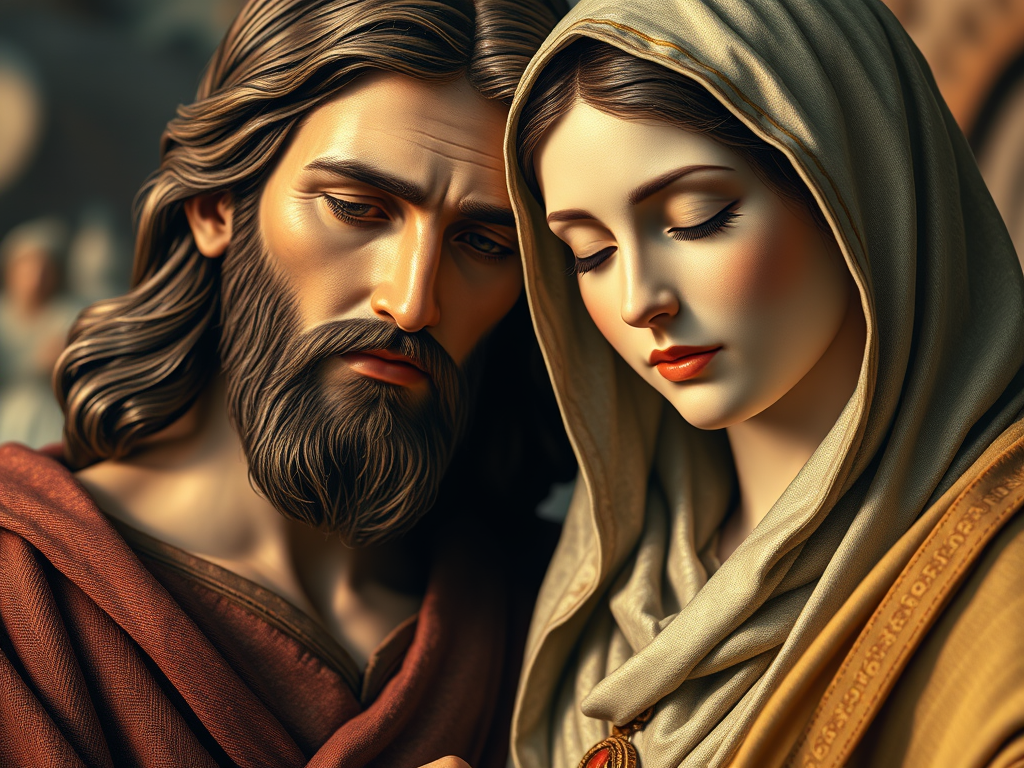
The story of Jesus and Mary is one of the most influential narratives ever written — yet few people realize how it came to be written. What we read today as the Gospels, the New Testament, or even the Apocrypha are not single accounts from one moment in history. They’re the result of decades of oral storytelling, translation, and preservation by early followers who believed the life of Jesus was too powerful to be forgotten.
1. From Spoken Word to Written Word
Before anything was written, the story of Jesus and Mary lived in the voices of people.
Early followers of Jesus — eyewitnesses, family members, and disciples — passed stories down through spoken memory. In the first century, most teaching was oral. People remembered details through repetition, songs, and parables.
Mary’s story, too, was told this way. She wasn’t just known as the mother of Jesus; she was honored as a symbol of faith and courage within these early gatherings. But for nearly a generation after Jesus’s death, there was no book, no manuscript, and no Bible — only memory.
2. The First Writers
The earliest written records about Jesus didn’t come from the Gospels — they came from letters written by Paul, around 50–60 CE.
Paul’s writings were meant to guide new Christian communities across the Roman Empire. His letters focused more on the meaning of Jesus’s death and resurrection than on his daily life. Mary is only mentioned briefly, but Paul’s writings began to shape the idea of Jesus as the Christ — the chosen one.
Then, around 65–70 CE, the first Gospel appeared: The Gospel of Mark.
Mark’s account was short, direct, and urgent. It was likely written for a persecuted audience that needed hope. Soon after, Matthew and Luke expanded Mark’s story, adding details about Jesus’s birth — and with that, Mary’s role became central.
By the time John was written (around 90–110 CE), the story had deepened into a spiritual narrative, presenting Jesus as the divine Word made flesh — and Mary as the human vessel through whom that divine creation entered the world.
3. The Forgotten and the Forbidden
Not all writings about Jesus and Mary made it into the Bible.
Early Christian communities were diverse — some followed Peter, others followed Thomas, and others still followed Mary Magdalene. Between the 2nd and 4th centuries, many alternative writings emerged, including The Gospel of Mary, The Gospel of Thomas, and The Protoevangelium of James (which describes Mary’s own miraculous birth and youth).
When church leaders began forming a unified canon — the official New Testament — they chose only four Gospels: Matthew, Mark, Luke, and John.
The rest were labeled apocryphal or heretical, not because they lacked beauty or insight, but because they didn’t align with the theology the early Church was building.
4. The Evolution of the Written Story
As centuries passed, the written story of Jesus and Mary evolved through translation and interpretation.
From Greek to Latin, from Hebrew roots to English Bibles, every era left its mark. Scribes copied manuscripts by hand. Artists and theologians added their own imagination — giving the world icons, hymns, and entire traditions inspired by the written word.
The story of Jesus and Mary became more than a record — it became a living text, reshaped by those who believed in it. Every translation, every sermon, every handwritten gospel was an act of faith — a way of keeping the story alive.
5. The Meaning of “Written” Creation
When we talk about the “creation” of the written story of Jesus and Mary, we’re talking about something larger than ink on parchment.
It’s the creation of meaning — of a message carried through time.
The words were written not just to record history, but to preserve a vision of divine connection between the human and the holy. Mary’s “yes” to creation and Jesus’s “yes” to sacrifice became symbols of faith, hope, and transformation — retold endlessly in the written and spoken word.
Final Thought
The written story of Jesus and Mary didn’t appear in a single moment — it was created over generations, through faith, memory, and the need to make meaning of something sacred.
In that sense, the act of writing itself became a kind of creation — the continuation of the divine story through human hands.
 Fit to Ball
You must be logged in to post a comment.